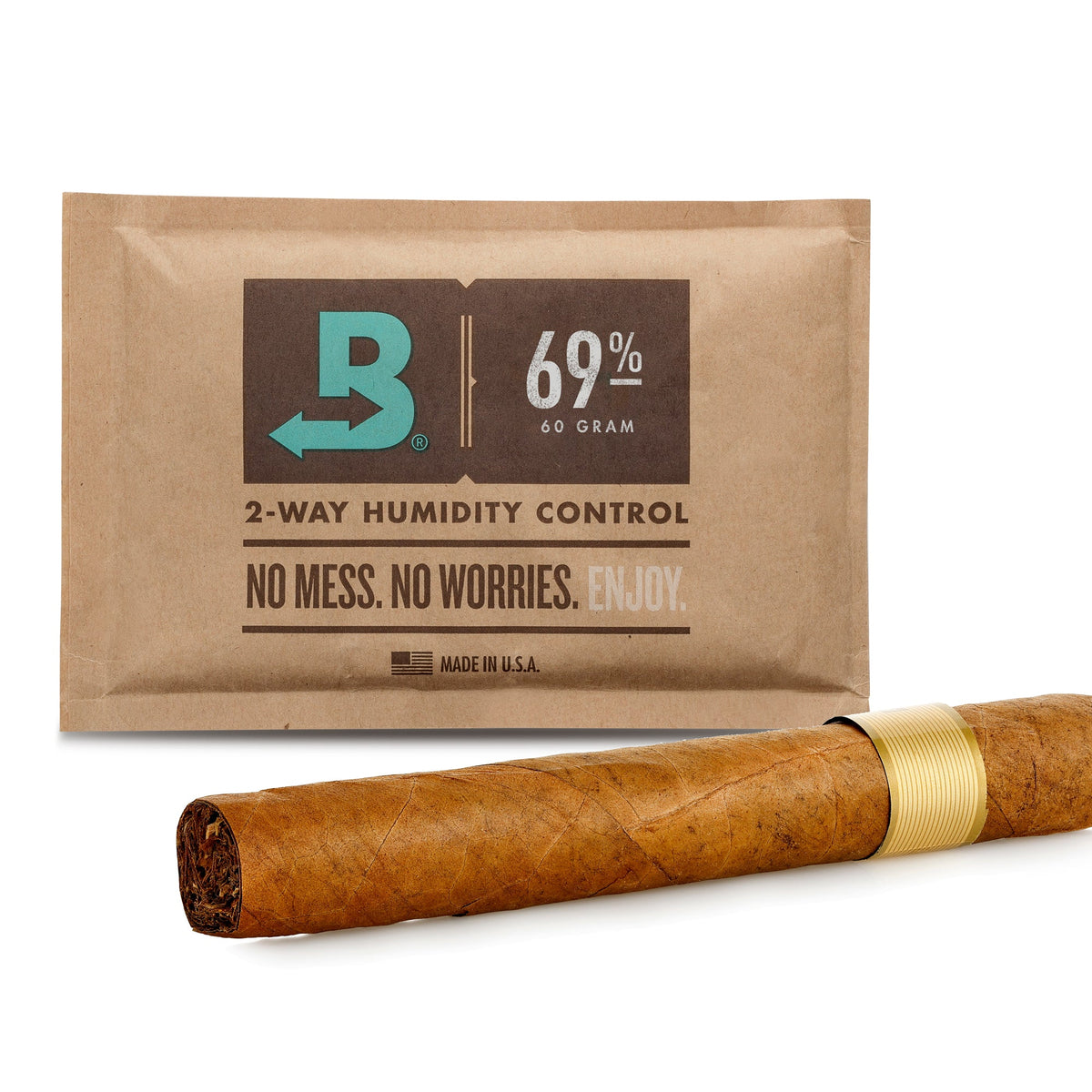
Short answer: slowly. Seal the dry cigars in an airtight container or humidor bag with Boveda 69% packs, one Size 60 for every 25 cigars or fewer, and leave them for about a month, which is Boveda's own method. If the wrappers are fragile and you'd rather go gradually, Boveda offers an optional route of 65% for four weeks, then 69% for four weeks, though it says its tests show stepping isn't necessary with 69%. Holt's starts at 62%, moves to 65% after two to three weeks and to 69% after another two to three weeks. Never add water directly. A cigar with a cracked or crumbling wrapper is usually past saving, and even a rescued cigar may lose some flavor.
How to tell if a cigar is too dry
- It crackles. Cigar Aficionado says to roll the cigar gently between your fingertips; a crackle like dry autumn leaves means it is too dry. Holt's says the same of a wrapper that cracks or crackles under a gentle squeeze.
- It has no give. Holt's says there isn't much give at all when you squeeze a dry cigar. JR Cigars' pinch test describes a healthy cigar as firm but elastic, with a bit of bounce, and a dry one as exceptionally firm, with cracking you can see or hear.
- The wrapper looks wrong. Boveda says a cracked or peeling wrapper indicates dryness, and that a faded or dull look can mean the same.
- The cap cracks when you cut it. Cigar Advisor says a dry cigar turns brittle, which makes the cap easier to crack.
- It smokes hot, fast and stale. Boveda lists a cigar that burns too hot and too fast, with stale flavor. Holt's says dried-out cigars burn at an accelerated pace, and The Manual says they taste mostly bitter.
Too wet looks different. Boveda says a moist cigar feels spongy and is hard to light and keep lit with an even ember, and JR Cigars says an overly humid cigar may not spring back to its shape. Vigilant adds mold, plume or a swollen end as signs.
Can a dried-out cigar be saved?
Often, if the wrapper is still whole. Boveda says that if the wrappers are intact, there's a good chance you can rehydrate a dry cigar, but not to expect a miracle from one with a cracked wrapper. Holt's says a cigar whose wrapper is tattered and disintegrating, or one left out of a humidor for several weeks or months, is generally beyond saving. Cigar Aficionado is the most pessimistic: most of the time, it says, dried-out cigars have to be written off, though in some cases they can be reconditioned through weeks in a good humidor, a tricky business it leaves to someone with great patience and experience.
Expect some flavor loss. Holt's says dried-out cigars may lose some of the flavor you'd normally expect, Cigar Inspector tells you to expect some lost flavor, and Cigar World says the drier a cigar has become, the less likely it is to fully recover. Cigar Advisor is more hopeful: if the cigars haven't lost their bouquet, it says, they should keep their character.
Why it has to be slow
Boveda and Holt's both say premium cigars lose moisture about four times faster than they can safely gain it. The trouble is that a cigar's layers take on moisture at different rates. Cigar Aficionado calls it disastrous for the layers to become moist or dry out at different rates, and Northwoods Humidors says rapid rehydration can split the wrapper as the tobacco expands unevenly. Holt's is blunter: a sudden surge of humidity can make dry cigars burst, and jumping straight to 75 or 80% shocks them and cracks the wrappers.
Method 1: Boveda's way (airtight container)
Use an airtight container, such as a tupperdor or a humidor bag, and one Boveda Size 60 for every 25 or fewer cigars. Boveda says not to mix RH levels in the same container.
| How dry? | Step 1 | Step 2 | Then |
|---|---|---|---|
| Dry | Boveda 69% for about a month | — | Smoke one. If it still burns too hot, give the rest another two weeks at 69%. |
| Fragile wrappers (Boveda's optional gradual method) | Boveda 65% for four weeks | Boveda 69% for four weeks | If one still burns too fast, another two weeks at 69%. |
Boveda suggests checking readiness with the CigarMedics HumidiMeter, a probe inserted into the head or foot of the cigar; a reading between 60 and 70% RH, it says, means the cigar is ready to smoke.
Method 2: Holt's stepped schedule
Holt's starts lower: put the cigars in a sealed container with a 62% pouch, swap it for 65% after two to three weeks, then for 69% after another two to three weeks. The drier the cigars, Holt's says, the longer they should spend at each level. It also suggests moving the top row of cigars to the bottom, and vice versa, along the way.
Method 3: Inside your humidor
If you would rather use a humidor that is already at the right level, move the dry cigars in gradually. Cigar Aficionado says to move them from the outer corners toward the center over several weeks, and Cigar Advisor moves them a little closer to the humidifier each week. Northwoods warns against setting them right next to the moisture source, which can cause uneven rehydration and mold.
Other schedules you may see
| Source | Schedule |
|---|---|
| The Manual | 62% for about a week, then up to 65%, 69% and 72%, repeating the process at each step; the reading should hold steady for at least 24 hours |
| Athlon Outdoors | 60 to 62% for about two weeks, 65 to 68% for two to three weeks, then a 70 to 72% humidor |
| Vigilant | Start around 50% and raise it about 3% a week until you reach about 70% |
| JR Cigars | Boveda 72% packs straight away, with improvement after a few days |
JR's straight-to-72% route, which it gives for severely dried-out cigars, is the most aggressive here. Cigar World also allows a 69 to 72% pack straight away, and Boveda's main method goes straight to 69%; the other schedules above start lower and step up.
Cellophane on or off?
The sources split. For extreme cases, when the cigar is basically a rock, Mike's Cigars suggests starting with the cellophane on so it rehydrates slowly, then removing it once the cigar feels slightly less firm. Simply Cigars says to remove cellophane sleeves, cedar tubes and aluminum tubes before you start because they slow the process. Both agree that cellophane slows things down.
What not to do
- No direct water. Cigar World says not to microwave cigars, dunk them in water or sponge them down. Athlon says not to soak them or wrap them in a wet cloth, and Simply Cigars says humidity should always come from the surrounding air, never from direct moisture or misting. (Not every source agrees. NewAir suggests steaming an open box of cigars in the bathroom during a hot shower, or wrapping a cigar in a damp paper towel for two weeks, and Northwoods Humidors suggests a damp sponge kept away from the cigars in a sealed bag. Boveda, Cigar World, Athlon and Simply Cigars warn against wet sponges, soaking or direct moisture.)
- No tap water. Cigar World says tap water can cause mold.
- No fridge or freezer. Athlon says not to put dry cigars in the refrigerator or freezer to rehydrate them.
- No wet sponges, crystals or beads. Boveda says these one-way methods shock cigars with too much moisture too quickly, and don't know when to stop.
- Don't go straight to high humidity. Cigar Inspector says not to put extremely dry cigars straight into a fully charged humidor, and Cigar Advisor wouldn't go as high as 85%.
How long it takes
| Source | Total time |
|---|---|
| Boveda | About a month at 69%, or eight weeks or more with the 65% step |
| Cigar Advisor | Could be at least a month, depending on how dry |
| Athlon Outdoors | A month or more from start to finish |
| Cigar World | About a month; closer to a couple of months if completely dried out |
| Holt's | Often several weeks or months |
Let them rest before you judge them
Holt's says to wait until the cigars have held the desired humidity for a period of weeks before you go back to smoking them, and Athlon gives them at least a couple more weeks. Simply Cigars suggests resting them 6 to 12 months and says small bubbles under the wrapper are nothing to panic about. A rehydrated cigar should not crack or crackle, Holt's says, and Mike's Cigars says it should feel slightly spongy and bounce back when squeezed. (Simply Cigars, by contrast, describes a revived cigar as supple, with a faint crackle when gently squeezed.) Cigar Inspector adds that if you have never smoked a particular cigar before, a revived one probably won't give you an accurate idea of its quality.
Keeping cigars from drying out again
Out of a humidor, cigars dry quickly. Cigar Aficionado says they start to dry out within a day, and Boveda gives cigars in a closed box a few days to two weeks at most, and cigars in cellophane or tubes a day or two. Holt's recommends storing cigars at 65 to 70% RH and 65 to 70°F, and treats 72% as the safe ceiling.
- Seal. Halfwheel's test for a humidor lid: lay a dollar bill halfway across the edge, close the lid and see if you can slip it out.
- Measure. Cigar Aficionado says to start by checking that your hygrometer is properly calibrated. See our hygrometer guide.
- Replace packs on time. Cigars International says to replace a Boveda pack once it becomes hard and stiff, and Holt's once it stiffens up. Boveda says to replace packs every three months, and not to wait until a pack is completely solid.
- Travel with protection. Boveda notes that humidity in an airplane cabin is usually below 20%, so pack cigars in a sealed travel case with a humidity pack.
In the desert. Boveda warns smokers in arid climates and at high altitude to watch out for dry cigars, and halfwheel describes Phoenix humidity creeping into the single digits at its driest, saying climate mainly changes how strict you must be. Our suggestion for Yuma: an airtight container or a well-sealed humidor, Boveda 69%, and a hygrometer you check every week or two. Our cigar storage guide and how long cigars last go further.
Boveda packs for rehydrating
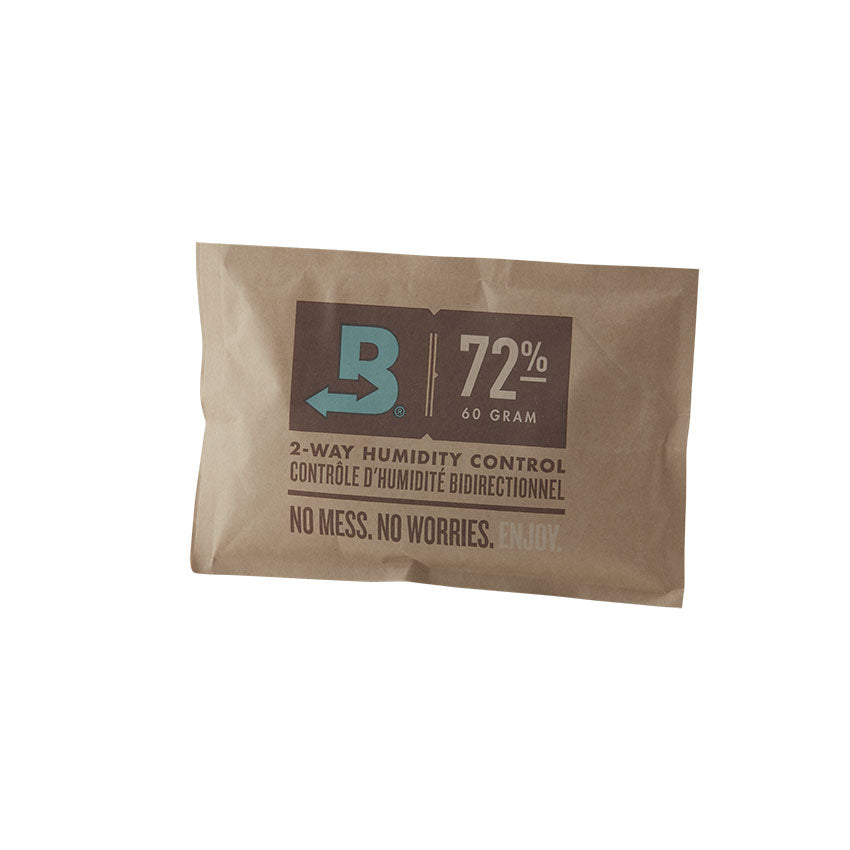
We stock Boveda Pack 69%, the Size 60 Boveda uses for its rehydration method, one per 25 cigars. We don't carry 65%, the first step of Boveda's gradual method. Boveda Pack 72% and Boveda Pack 75% are for humidors in dry rooms; Boveda says not to use 75% in airtight containers. Every cigar order from our humidor ships with a Boveda pack. Browse Boveda and humidification and cigar humidors, and see how Boveda packs work.
$9.99 flat shipping, free on orders of $125 or more.
Frequently asked questions
Can you rehydrate a dry cigar?
Often, yes. Boveda says that if the wrapper is intact, there's a good chance a dry cigar can be rehydrated. A cracked, tattered or crumbling wrapper usually means it is past saving.
How do you rehydrate cigars with Boveda?
Seal them in an airtight container or humidor bag with Boveda 69%, one Size 60 per 25 or fewer cigars, for about a month. If the wrappers are fragile, Boveda offers an optional gradual route: 65% for four weeks, then 69% for four weeks.
How long does it take to rehydrate cigars?
Often a month or more, though estimates run from a few days (Mike's Cigars) to several months (Holt's). Boveda's standard method takes about a month, and its optional gradual method about eight weeks.
What Boveda percentage should I use to rehydrate cigars?
Boveda uses 69% and says stepping up isn't necessary; for fragile wrappers it offers 65% first. Holt's steps through 62%, 65% and 69%. Avoid jumping to high humidity; Holt's says 75 to 80% shocks dry cigars and cracks the wrappers.
How can you tell if a cigar is dried out?
It crackles when rolled or squeezed gently, has little give, and may show a cracked or peeling wrapper. Dry cigars also burn hot and fast and taste stale or bitter.
Is it okay to smoke a dry cigar?
It will smoke poorly. Holt's says dried-out cigars burn at an accelerated pace, and The Manual says they taste mostly bitter. Rehydrating first gives the cigar a better chance.
Why do cigars crack when rehydrated too fast?
The layers of a cigar take on moisture at different rates. Cigar Aficionado says it is disastrous for the layers to become moist or dry out at different rates, and Northwoods Humidors says rapid rehydration can split the wrapper as the tobacco expands unevenly.
Should I take the cellophane off to rehydrate cigars?
Sources disagree. Mike's Cigars leaves it on at first for severely dry cigars, to slow things down; Simply Cigars removes it because it slows the process.
Will a rehydrated cigar taste the same?
Often not. Holt's says the natural oils lost to drying don't come back, so a rehydrated cigar won't taste quite as the cigarmaker intended, though it needn't taste bad. Cigar World says the drier the cigar got, the less likely it is to fully recover.
How fast do cigars dry out without a humidor?
Cigar Aficionado says they start to dry out within a day. Boveda gives a closed box a few days to two weeks at most, and cigars in cellophane or tubes a day or two.
Sources: Boveda, "Rehydrate Cigars: How to Rehumidify Dry Cigars with Boveda" (June 2022), "Reviving Dried Cigars with Boveda" (2017), "How to Tell if a Cigar Is Dry or Moist" (April 2024), "How Long Do Cigars Last?" (April 2024), "How to Use Your Boveda Humidor Bag," "When Do I Replace Boveda for My Cigars?" and "What Boveda RH Do I Need for My Cigars?"; Holt's Clubhouse, "How to Re-humidify Your Dry Cigars" (November 2018, updated 2026), "Can You Smoke a Dried-Out Cigar?" (January 2021), "How to Fix Common Cigar Problems" (August 2019) and "Humidor Maintenance & Care Tips" (May 2022); Cigar Aficionado, "Storing Cigars" (March/April 1998 issue), "How Long Can Cigars Stay Fresh?" (December 2016) and "What Causes a Cigar Wrapper to Crack?" (January 2017); Famous Smoke Shop's Cigar Advisor, "How Can I Rehydrate My Dry Cigars?" (October 2010) and "How to Fix Over Humidified & Under Humidified Cigars" (November 2014); Cigars International, "How to Use Boveda Humidity Packets"; JR Cigars, "How to Revive Dry Cigars" (March 2020) and "What Is the Cigar Pinch Test?" (September 2015); Northwoods Humidors, "How to Rehydrate a Cigar" (April 2024); halfwheel, "Ask halfwheel: Does Climate Affect How You Should Store Cigars?" (July 2016) and "Ask halfwheel: My Cigars Are Dry" (February 2017); Mike's Cigars, "How to Revive Hard and Dry Cigars" (February 2019); Simply Cigars, "Can a Dried Cigar Be Revived?"; Cigar Inspector, "How to Revive Dried Cigars" (April 2024); Cigar World, "How to Rehydrate Cigars: 2025 Edition" (May 2025); Athlon Outdoors, "Fix That Stick – How to Save Dry Cigars" (October 2025); The Manual, "How to Rehydrate a Dry Cigar (and Everything You Need to Know)" (March 2024); NewAir, "How to Save Dry Cigars vs. Damp Cigars"; Vigilant, "How Do I Salvage Dried Out Cigars?" and "How Can I Tell if My Cigars Are Too Moist?" (July 2021).