The main types of cigars are premium handmade cigars with long filler, machine-made cigars with short filler, cigarillos and little cigars, and flavored or infused cigars. Premium cigars are then sorted four ways: by shape (straight parejo or shaped figurado), by size (length by ring gauge), by wrapper leaf and by strength.
Each type below is defined from Cigar Aficionado, the FDA and the makers, with Opus X, Padrón and Liga Privada as examples.
What are the main types of cigars?
Federal rules define a cigar as tobacco rolled in leaf tobacco or in a substance containing tobacco. That covers everything from a hand-rolled Churchill to a filtered little cigar.
Premium handmade (long-filler) cigars
Cigar Aficionado describes a hand-rolled, or handmade, cigar as one made entirely by hand from long filler and a high-quality wrapper; long filler is whole leaf running the length of the cigar. Makers list all three leaves: Drew Estate gives Liga Privada No. 9 a Connecticut River Valley Broadleaf wrapper, a Brazilian Mata Fina binder and filler from Nicaragua and Honduras.
Machine-made and short-filler cigars
Machine-made cigars, per Cigar Aficionado, mostly use short filler (chopped scrap leaf, also called picadura), which burns faster and hotter than long filler. Many are wrapped or bound in homogenized tobacco leaf, a sheet of shredded scrap tobacco and cellulose developed in the 1950s to cut costs and not used in premium cigars.
Cigarillos and little cigars
Cigar Aficionado calls cigarillos short, thin cigars that are popular in Europe and usually machine-made. Little cigars, says the FDA, resemble cigarettes in size and shape and are labeled little or filtered cigars. Federal rules class cigars weighing up to three pounds per thousand as small cigars. Premium small formats exist too, such as the 4 x 32 Liga Privada No. 9 Coronets; see our cigar tins & cigarillos.
Flavored and infused cigars
Drew Estate describes its ACID Blue line as aromatic cigars infused with sweet, herbal flavors, made with its proprietary curing and blending methods. Our flavored and infused cigars guide covers the lines we stock, from ACID and Deadwood to Java and Tatiana.
What is the difference between a parejo and a figurado?
Cigar Aficionado sorts shapes into two families. A parejo is straight-sided, usually with an open foot and a closed head you cut, and can be round or box-pressed. A figurado is any cigar that is not a straight-sided cylinder.
Parejo shapes
The corona is the benchmark parejo. Around it sit the petit corona, robusto, toro, Churchill and double corona, the slim panetela and lancero, and the thick gordo (the magazine's grande, 60 ring and up). Cigar Aficionado traces the lancero to Cohiba at the El Laguito factory in the 1960s.
Figurado shapes
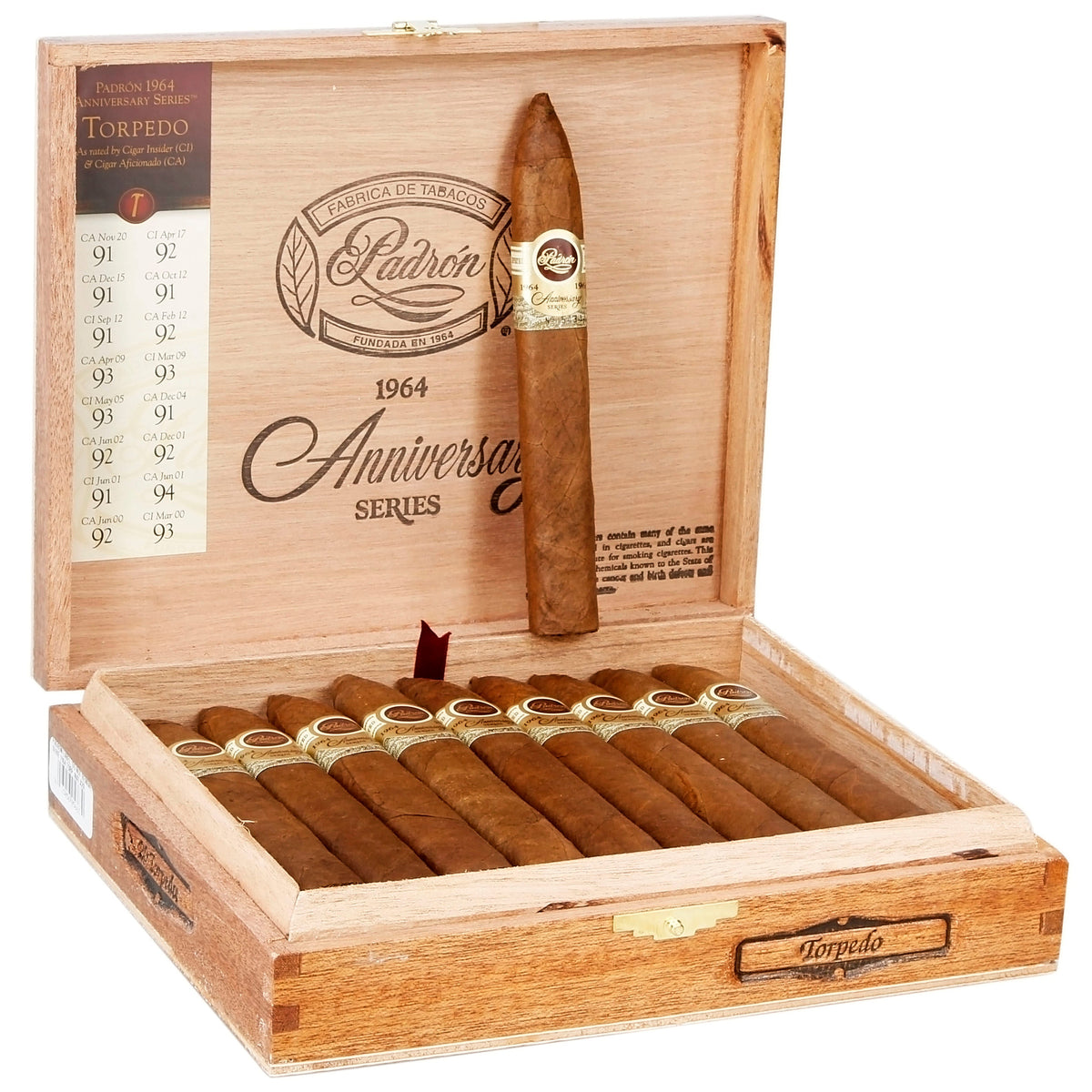
- Pyramid and torpedo. A tapered head and an open foot; the torpedo has a sharper point. Padrón lists its 1964 Anniversary Series Torpedo at 52 x 6.
- Belicoso. A shorter pyramid, often a corona or corona gorda with a tapered head. Drew Estate lists the Liga Privada No. 9 Belicoso at 6 x 52.
- Perfecto. Tapered at both ends with a bulge in the middle. Arturo Fuente's Hemingway perfectos run from the 4-inch Short Story to the 9-inch Masterpiece.
- Salomón. A very large diadema-type figurado with a pointed head and a bulbous, nippled foot; Cigar Aficionado says a top roller makes only 50 to 60 a day.
- Culebra. Three panetelas braided together and smoked one at a time.
Shop them in our torpedo and figurado cigars.
Box-pressed cigars
Cigar Aficionado explains that cigars packed tightly in a box, usually a flat-top one, take on a slightly square shape, while trunk pressing, with wooden slats between the cigars, squares them sharply. Padrón introduced its 1964 Anniversary Series as a box-pressed line honoring the Cuban tradition, ages its tobacco four years and offers all sixteen sizes in sun-grown Natural and Maduro. The 1926 Serie is box-pressed too. See all Padrón cigars or every box-pressed cigar.
What size is a robusto, toro or Churchill cigar?
Size is written as length in inches by ring gauge, the diameter in 64ths of an inch. These are Cigar Aficionado's typical figures. Sizes vary by maker, and some put ring gauge first, as Padrón does with the 50 x 5½ 1964 Exclusivo.
| Shape | Typical length (inches) x ring gauge |
|---|---|
| Petit Corona | About 4½ x 40 to 42 |
| Corona | 5½ to 6 x 42 to 44 |
| Robusto | 4¾ to 5½ x 48 to 52 |
| Toro (Corona Gorda) | Traditionally 5⅝ x 46; 6 x 50 is also popular |
| Churchill | 7 x 47 |
| Double Corona | 7½ to 8½ x 49 to 52 |
| Lancero (gran panetela) | Over 7 x 34 to 38 |
| Gordo (Grande) | 4¾ and up x 60 and up |
| Belicoso | 5 to 5½ x about 50 |
| Pyramid or Torpedo | 6 to 7; about 40 at the head, 52 to 54 at the foot |
| Perfecto | Varies widely |
| Culebra | 5 to 6 x 38, three braided |
| Salomón | Cuaba Salomon: 7¼ x 57 |
Figures are from Cigar Aficionado's shapes guide and, for the Salomón, its glossary. Thin cigars tend to burn hotter than thick ones, the magazine adds. For smoking times, see our cigar size and ring gauge chart and toro vs. robusto.
What are the types of cigar wrappers?
A wrapper is named for its seed or region (Connecticut, Cameroon, Corojo) or for its color after processing (Candela, Maduro, Oscuro). Cigar Aficionado notes that sun-grown wrapper is thicker and usually darker than shade-grown leaf of the same strain.
| Wrapper | What it is | Example |
|---|---|---|
| Connecticut Shade | Grown under cloth in the Connecticut River Valley from Sumatra-derived seed; thin, golden-brown, mild. Ecuador grows the seed too. | Padrón Dámaso (Ecuadorian Connecticut) |
| Connecticut Broadleaf | Sun-grown and stalk-cut; broad leaves that cure dark, used on many maduros. | Liga Privada No. 9 |
| Habano | The Cuban term for an all-Cuban cigar; Habano seed in Ecuador yields a dark, oily, rich leaf. | — |
| Corojo | Cuban seed bred in the 1930s at the El Corojo plantation; its descendants grow in Central America and the Caribbean, while Cuba no longer grows it. | Opus X |
| Cameroon | A dark, toothy leaf from West Africa. | Oliva Serie G Cameroon |
| Sumatra | Sumatra seed grown in Ecuador gives a darker, stronger, oilier leaf than Connecticut seed. | Oliva Serie V Melanio (Ecuadorian Sumatra) |
| San Andrés | Stalk-cut Mexican leaf prized for maduro wrappers. | E.H. Taylor San Andres |
| Maduro | A shade: deep reddish-brown to nearly black from longer fermentation in heat; robust, nearly sweet. | Padrón 1964 Maduro |
| Oscuro | The darkest shade, nearly black; also called negro or double maduro. | Hemingway Classic Sungrown Oscuro |
| Candela | Green, heat-cured to lock in chlorophyll; nearly all the cigars Americans smoked from about 1958 to the early 1970s were candelas. | Arturo Fuente Flor Fina 8-5-8 Candela |
Definitions follow Cigar Aficionado; examples come from makers' listings or our catalog. Browse Connecticut shade cigars or maduro cigars. Our cigar wrapper types guide covers each wrapper in depth, from where it grows to how sources describe its flavor.
How strong is each type of cigar?
Cigar Aficionado says size does not indicate strength, which comes from the tobacco and varies by brand. Color can mislead too: in September 2025 the magazine's Thomas Pappalardo wrote that a dark maduro can seem overwhelmingly strong, though that is not always so. Go by the maker's rating: Padrón calls Dámaso mild to medium and the 1926 Serie full-bodied, and Drew Estate rates Liga Privada No. 9 full. Browse mild cigars or full-bodied cigars.
How do Opus X, Padrón and Liga Privada fit these types?
Opus X
Arturo Fuente calls OpusX the first Dominican puro, its wrapper grown in soil once thought unsuitable for wrapper tobacco. Cigar Aficionado says the brand debuted in November 1995 and that its dark, oily Corojo Cuban-seed wrapper grows at Chateau de la Fuente. See Opus X cigars.
Padrón
The 1964 Anniversary Series runs from the 4-inch Hermoso to the 8¼-inch "A", every size box-pressed and offered in Natural or Maduro, with figurados such as the Torpedo and Belicoso.
Liga Privada
No. 9 pairs a dark, stalk-cut Broadleaf wrapper with full strength. Drew Estate offers it from the 4 x 32 Coronets to the 7 x 54 Corona Doble, plus the 6 x 52 Belicoso and the 3 15/16 x 60 Flying Pig. See the Liga Privada family.
Which type of cigar should you start with?
House suggestions. Our own views from the lounge, not sourced facts.
- New to cigars: a robusto in a mild Connecticut shade wrapper, then move up in strength.
- To learn what a wrapper does, smoke one Padrón 1964 size in Natural and Maduro side by side.
- Short on time: a small cigar from a tin rather than a large cigar left half-smoked.
Types of Cigars FAQ
What are the main types of cigars? Premium handmade cigars with long filler, machine-made cigars with short filler, cigarillos and little cigars, and flavored or infused cigars.
What is the difference between a parejo and a figurado? A parejo is straight-sided, either round or box-pressed. A figurado is any other shape, such as a torpedo, belicoso, perfecto, salomón or culebra.
What is the difference between premium and machine-made cigars? Premium cigars are rolled by hand from long filler and a quality leaf wrapper. Cigar Aficionado says most machine-made cigars use short filler, often with a homogenized tobacco wrapper or binder.
Is a maduro or darker cigar stronger? Not necessarily. Cigar Aficionado says strength comes from the tobacco, and a dark maduro is not always as strong as it looks. Check the maker's strength rating.
What size is a Churchill cigar? Cigar Aficionado gives 7 x 47 as the classic Churchill size. Makers vary it: Padrón lists its Padrón Series Churchill at 46 x 6⅞.
Where can I buy premium cigars in Yuma, AZ? At Sun of a Gun Cigars & Spirits, 1651 S Arizona Ave, an official J.C. Newman Diamond Crown Cigar Lounge with a walk-in humidor. Call 928-276-3500 with questions.
Sources
- Cigar Aficionado: Cigar Shapes, Sizes and Colors
- Cigar Aficionado glossary (filler, wrapper, shape and color terms)
- Cigar Aficionado on OpusX (April 2020)
- Cigar Aficionado on maduros (September 2025)
- FDA: Cigars, Cigarillos, Little Filtered Cigars
- 27 CFR 40.11
- Drew Estate: Liga Privada No. 9, ACID Blue
- Padrón: 1964, 1926, Padrón Series, Dámaso
- Arturo Fuente: OpusX, Hemingway
Ready to compare types side by side? Start with robusto cigars for an easy look across wrappers, or go straight to Liga Privada No. 9 cigars for a full-strength Broadleaf benchmark. $9.99 flat shipping, free on orders of $125 or more. Every order ships with a Boveda humidity pack. Ships within 1–2 business days.